
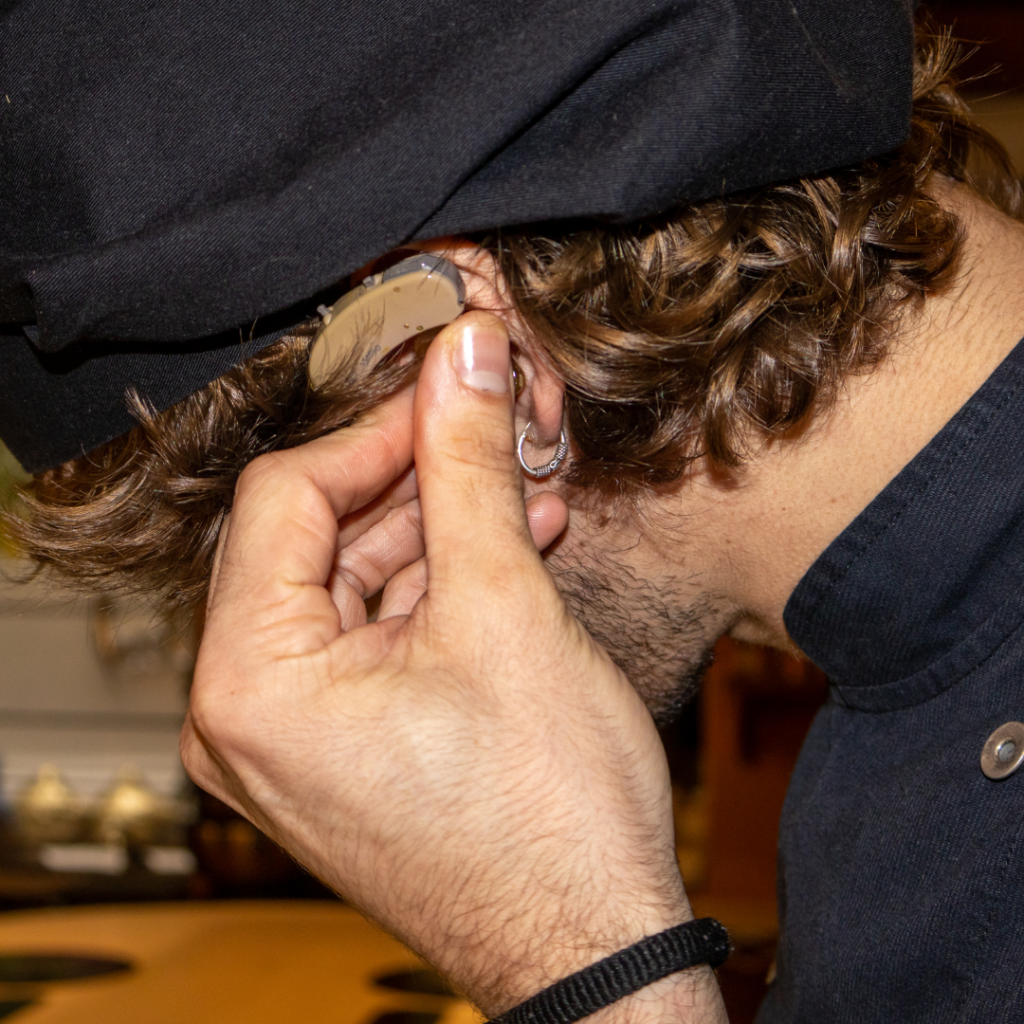
Following dinner conversations becomes challenging when high ambient noise interferes with your focus and hearing. Our specialists can evaluate hearing under both calm and noisy listening conditions to establish why noisy rooms present such difficulty. After uncovering the precise factors driving your difficult hearing, our team helps you select individualized auditory solutions.
Understanding the Contrast Between Quiet Hearing and Restaurant Noise
In quiet conditions, an optimal signal-to-noise ratio ensures that the desired speaker sounds markedly clearer than surrounding sound. Commercial restaurant spaces present the polar opposite acoustic dynamic. Cross-talk, ambient music, dishware noise, and harsh acoustic reverberation interfere with speech clarity, forcing your brain to labor to extract the target voice.
Such difficulty frequently signals sensorineural high-frequency hearing loss, auditory processing dysfunction, or noise-induced cochlear damage. Attention, fatigue, dim lighting, and distance from the speaker may make it worse. Numerous individuals show standard hearing thresholds on paper but reveal marked comprehension drops on clinical speech-in-noise testing. Disproportionate difficulty in restaurants justifies professional clinical assessment even if your everyday home hearing appears intact.
Diagnostic Protocols for High-Frequency Hearing Loss
We initiate evaluation by exploring challenging acoustic environments, acoustic trauma history, subjective tinnitus, prescription drug profiles, and unilateral ear changes.
Through pure-tone audiometry, we determine your faintest auditory perception across low to high pitches utilizing both air and bone conduction testing. Sensorineural high-frequency hearing loss demonstrates an audiometric slope reflecting diminished hearing thresholds as sound frequencies climb. Extended test batteries incorporate acoustic tympanometry to rule out middle-ear pathology along with suprathreshold word-recognition testing.
Because testing in a silent booth does not mirror real-life restaurant environments, speech-in-noise testing supplies vital diagnostic clarity. It measures how well you recognize words or sentences as competing sounds become louder. In combination, these diagnostic metrics reveal whether communication hurdles involve audibility thresholds, speech discrimination, neural noise management, or mixed conditions.
The Role of Central Auditory Processing Disorders in Adults
A diagnosed auditory processing disorder affects how the brain’s auditory cortex analyzes, organizes, and interprets sound. The ears may detect tones at expected levels, but the brain may have difficulty organizing competing signals, distinguishing similar speech sounds, or following rapid conversation. Our protocol begins by thoroughly testing peripheral hearing before determining if a specialized central auditory-processing battery or interdisciplinary referral is warranted.
Actionable Listening Tips for Noisy Social Settings
Minor environmental adjustments can boost speech acoustic signals and supply critical visual lip-reading cues. Before leaving home, identify quieter dining venues or plan to eat during less crowded service times. Restaurants featuring plush booths, wall acoustic panels, heavy drapery, carpeting, and sound-dampening materials provide superior listening compared to open rooms with reflective surfaces.
At the restaurant:
- Ask for seating positioned far away from open kitchens, noisy bar areas, ceiling speakers, and large parties.
- Sit with your back near a wall to reduce noise coming from behind you.
- Face your conversation partners in good lighting.
- Reduce physical spacing between yourself and companions to maximize direct speech perception.
- Position your better-hearing ear directly toward your main conversational partner.
- Instruct conversational partners to reword missed phrases instead of repeating the entire sentence verbatim.
- Validate significant pieces of information directly rather than feigning understanding during dialogue.
- Excuse yourself for a momentary quiet pause when listening exhaustion starts to mount.
- Ask dinner guests to speak with clear enunciation at a steady, natural conversational rate.
- Elevated yelling distorts auditory signals and seldom improves actual phonetic comprehension.
Assistive Listening Technologies for Noisy Environments
Appropriate hearing technology is dictated by the precise diagnosis, primary listening environments, and the degree of diagnosed hearing loss. Modern clinical hearing aids integrate directional microphone polar patterns, automated digital noise suppression, and personalized restaurant memory settings to highlight frontal speech and reduce background competition. Users should establish realistic expectations because no hearing device can fully eradicate all unwanted ambient speech.
Utilizing an external remote microphone can deliver a dramatically superior signal-to-noise ratio. The microphone is placed near or worn by the speaker and sends that voice directly to compatible hearing aids or another receiver. Direct audio routing minimizes the acoustic penalty of conversational distance and surrounding environmental din.
Alternative assistive hearing tools include:
- Dedicated table microphones engineered to capture small-group dialogue
- Hearing-loop telecoils that stream clean audio in loop-equipped establishments
- Smartphone speech-to-text or live-captioning applications
- Earbuds or hearables with compatible assistive-listening features
- Sound-level or restaurant-review tools for finding quieter locations
We will help compare available technology, verify device compatibility, and instruct you on utilizing your selected hearing equipment.
The Clinical Role of Audiologists in Managing Loud Environments
A comprehensive hearing evaluation looks far beyond the common misconception of “I hear fine in quiet environments.” Our audiology team assesses the unique environments, speaking partners, and ambient noise profiles that challenge you to choose targeted diagnostic tools. Testing routinely combines pure-tone audiometry, middle-ear impedance tests, speech discrimination, and speech-in-noise measures. Dedicated central auditory-processing testing will be scheduled if your history and primary diagnostic testing indicate central pathway issues.
Sudden unilateral hearing drops, acute asymmetric changes, or rapid auditory decline mandate evaluation by an ear, nose, and throat physician. Personalized care identifies the source of the difficulty rather than assuming restaurant noise is the only problem.
Arrange a Hearing Evaluation With Us Now
If crowded restaurant settings cause you to feel disconnected, tired, or forced to guess at conversations, arrange a diagnostic hearing evaluation today. Our specialists can introduce effective interventions to support your hearing in noisy environments via precision hearing aid fittings, assistive devices, or audiological rehabilitation.
Contact our practice today to book your consultation and take a decisive step toward reconnecting in social settings.